- BookMagiks 802, Solaris Business Hub, Sola Road, Naranpura, Ahmedabad
- info@bookmagiks.com
Warning: include(): open_basedir restriction in effect. File(../book_magiks/wp-content/themes/cachild/inc/main-header.php) is not within the allowed path(s): (C:/Inetpub/vhosts/bookmagiks.com\;C:\Windows\Temp\) in C:\inetpub\vhosts\bookmagiks.com\httpdocs\wp-content\themes\cachild\page-ar-and-ap-management-services-old.php on line 934
Warning: include(../book_magiks/wp-content/themes/cachild/inc/main-header.php): Failed to open stream: Operation not permitted in C:\inetpub\vhosts\bookmagiks.com\httpdocs\wp-content\themes\cachild\page-ar-and-ap-management-services-old.php on line 934
Warning: include(): Failed opening '../book_magiks/wp-content/themes/cachild/inc/main-header.php' for inclusion (include_path='.;.\includes;.\pear') in C:\inetpub\vhosts\bookmagiks.com\httpdocs\wp-content\themes\cachild\page-ar-and-ap-management-services-old.php on line 934
AR and AP Management Services
Home / AR and AP Management Services
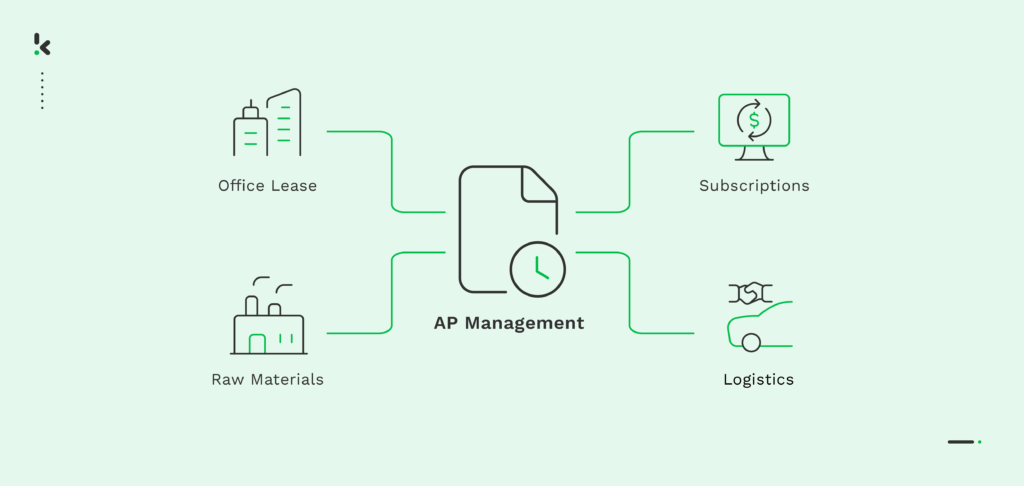
2024 Guide to Efficient Accounts Payable Management
In the dynamic world of corporate finance, mastering the art of accounts payable (AP) management is like discovering a hidden treasure that can significantly enhance your company's operational efficiency.
Imagine having a transformative tool at your disposal that not only automates your accounts payable processes but also optimizes your entire financial operations.
This guide is designed to unveil the importance of robust accounts payable management and introduce you to the revolutionary world of automation, with a special focus on how Klippa's technology solutions can redefine your financial workflows.
Understanding Accounts Payable Management
At the heart of every thriving business lies the crucial task of managing accounts payable effectively. This process involves monitoring the funds your business owes to its suppliers and creditors-a vital component that can significantly impact your company's liquidity, credit rating, and overall financial health.
AP automation is proving to be a transformative tool that promises to streamline accounts payable processes from invoice processing to payment processing and supplier management.
What is Accounts Payable Management?
Accounts payable management is the systematic approach to managing a company's obligations to pay off short-term debts to its suppliers or creditors. Its central role in business operations is undeniable, directly impacting a company’s cash flow and financial stability.
Other Services
Having Trouble Managing Your Finance?
Get a Free Quote
Accounts Payable vs. Accounts Receivable
To fully grasp the essence of accounts payable, it's essential to distinguish it from its counterpart, accounts receivable. While accounts payable represent the money a company owes, accounts receivable embody the money that is owed to the company. This balance between inflows and outflows is pivotal for maintaining a healthy financial state.
In the next section, we look at the risks associated with ineffective accounts payable management and the consequences this can have for companies to emphasize the importance of this aspect.
The Risks of Poor Accounts Payable Management
Failing to manage accounts payable effectively can leave your business vulnerable to a range of risks, such as:
- Late payments
- Damaged supplier relationships
- Risk for fraud & errors
- Cash flow problems
- Increased audit & compliance risk
- Impaired financial analysis and decision making
- Reputational damage
Late Payments and Penalties
Late payments disrupt business operations, cause cash flow problems for suppliers, and damage relationships. This can lead to penalties, financial strain, and reputational damage for both parties. In some cases, repeated delays can even lead to legal action or damage the company’s reputation in the industry.
Damaged Supplier Relationships
Timely and accurate payment is the cornerstone of strong supplier relationships. Without effective accounts payable management, delayed payments can become a recurring issue, eroding trust, and potentially damaging long-standing business relationships.
Risk for Fraud & Errors
A disorganized accounts payable process creates opportunities for fraud and accounting errors. Without stringent controls and verification procedures, companies may fall victim to fraudulent invoices, duplicate payments, or incorrect payment amounts. Such issues not only result in financial losses but can also compromise the integrity of financial reporting.
Cash Flow Problems
One of the main risks of ineffective accounts payable management is its negative impact on a company's cash flow. Late payments can lead to unnecessary late fees and interest, while poor management of payment terms can lead to missed opportunities for cash discounts.
Increased Audit and Compliance Risk
Inadequate monitoring of accounts payable can lead to non-compliance with regulations, resulting in legal and financial consequences. Inadequate accounting makes auditing more difficult and increases the risk of errors and breaches of regulations.
Impaired Financial Analysis and Decision Making
Effective accounts payable management provides valuable insights into a company's financial commitments and spending patterns. Without it, leaders lack crucial data needed for informed decision-making. This can lead to suboptimal allocation of resources, misguided financial planning, and missed opportunities for cost savings and investment.
Reputational Damage
Poor accounts payable management goes beyond financial losses and operational inefficiencies. Late payments or non-compliance can damage a company's reputation and impact partnerships and customer trust. In today's connected world, reputation is critical to success, underscoring the need for comprehensive and automated solutions.
By automating accounts payable management to streamline processes, enhance accuracy, and ensure compliance, businesses can mitigate these risks. Securing their financial health and positioning themselves for sustained success.
Advantages of Automated AP Management
The automation of accounts payable in accounting brings a multitude of advantages through efficient organization, such as enhanced invoice processing accuracy, timely payment execution, and effective supplier management. These elements collectively contribute to improved financial efficiency and reduced operational costs.
Several additional advantages include:
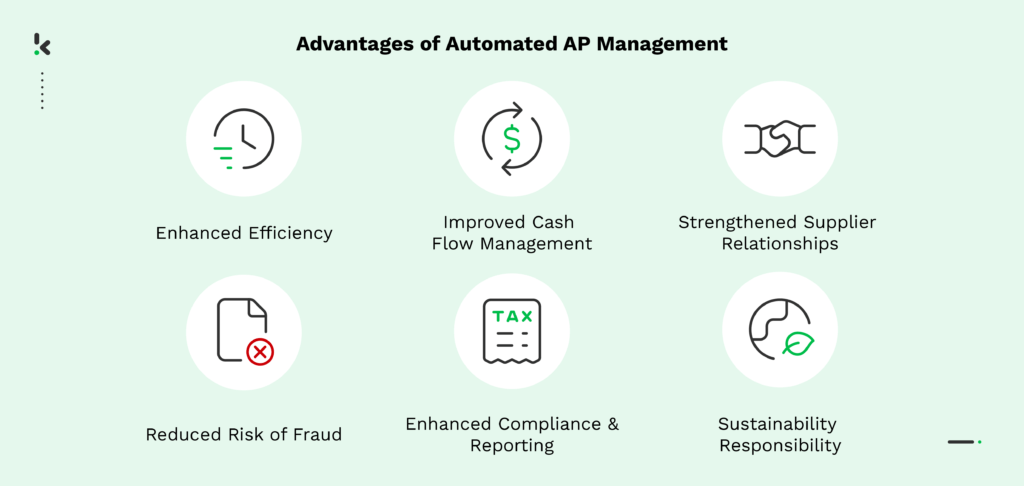
Enhanced Efficiency: Streamlining accounts payable through automation reduces manual work and saves time and resources. Automation speeds up the processing of invoices and payments and enables employees to prioritize strategic tasks.
Improved Cash Flow Management: Efficient accounts payable management improves cash flow control. Automating payment schedules helps secure cash discounts and avoid late payment penalties, optimizing working capital for healthier finances.
Strengthened Supplier Relationships: On-time, accurate payments promote supplier trust and loyalty. Optimized accounts payable ensures on-time payments to suppliers, which fosters positive relationships and potentially leads to better terms and pricing, which in turn strengthens financial stability.
Reduced Risk of Fraud: A robust accounts payable system reduces the risk of fraud through checks and balances. Automation increases security with consistent processes and transaction logs, helps with fraud detection and prevention, and protects financial integrity.
Enhanced Compliance and Reporting: Keeping up with regulatory compliance is a critical aspect of accounts payable management. Automated solutions help ensure that all payments are processed following relevant laws and regulations, reducing the risk of compliance issues.
Sustainability and Corporate Responsibility: The transformation to electronic invoices and payments as part of an automated accounts payable system reduces paper consumption and supports sustainability goals. This step is in line with the company’s social responsibility efforts and strengthens its reputation among all stakeholders.
10 Strategies for Efficient AP Management
To manage your accounts payable effectively, consider these best practices in AP:
Clear Guidelines
Develop a comprehensive accounts payable policy that clearly outlines responsibilities and workflows for purchase orders, invoice processing, and payment approvals. This ensures consistency and transparency in accounts payable operations, reducing the risk of errors and delays.
Create Operational Workflows
Develop structured workflows for accounts payable management, from invoice receipt and verification to payment approval and reconciliation. Clearly define roles, responsibilities, and escalation procedures to ensure accountability and facilitate seamless process execution.
Compliance and Record-Keeping
Adhere to regulatory requirements and internal policies regarding financial transactions. Maintain meticulous records of invoices, purchase orders, receipts, and payment documentation to facilitate audits and ensure compliance with accounting standards.
Expense Tracking
Implement robust expense-tracking mechanisms to monitor spending patterns, identify cost-saving opportunities, and manage budget allocations effectively. Utilize software solutions or integrated accounting systems to streamline expense reporting and analysis processes.
Account Reconciliation
Regularly reconcile accounts payable, including credit card transactions, to vendor statements, bank statements and general ledger entries to detect discrepancies and promptly reconcile outstanding balances. This also includes a thorough credit card reconciliation to ensure the accuracy of financial reports and minimize the risk of posting errors.
Improve Data and Invoice Accuracy
Implement measures to enhance the accuracy of data entry and invoice processing, such as data validation checks, two-way matching algorithms, and electronic data interchange (EDI) integration with suppliers. This minimizes errors, eliminates duplicate payments, and improves overall process efficiency.
Conduct Regular Audits
Periodically review accounts payable processes and procedures to identify inefficiencies, mitigate risks, and implement improvements. Audits help uncover discrepancies, validate compliance with internal controls, and optimize workflow efficiencies.
Centralize and Collaborate
Centralize accounts payable functions within a dedicated department or system to streamline communication, facilitate collaboration, and standardize organizational processes. Encourage cross-departmental collaboration between finance, procurement, and operations teams to optimize procurement practices and vendor relationships.
Foster Strong Supplier Relationships
Cultivate positive relationships with vendors and suppliers through effective communication, timely payments, and transparent dealings. Collaborate with suppliers to negotiate favorable terms, discounts, and payment schedules, fostering mutual trust and reliability.
Leverage Technology
Embrace advanced technology solutions, such as automated accounts payable software and electronic invoice processing systems, to streamline accounts payable operations and enhance efficiency. Automation reduces manual intervention, accelerates invoice processing times, and improves data accuracy.
Automated accounts payable software solutions are often the heartbeat of effective accounts payable management. They ensure your AP process is not just a cost center but a strategic asset that drives organizational success. This is why we believe Klippa SpendControl can be the right solution for you.
Klippa's Impact on Accounts Payable Efficiency
Klippa's innovative expense management and invoice processing solutions, such as Klippa SpendControl, use cutting-edge AI and cloud technologies to optimize your accounts payable. While ensuring efficiency, security and compliance from data extraction to final approval. The solution not only helps you overcome the traditional hurdles of paperwork, but also helps your business thrive in the digital landscape.
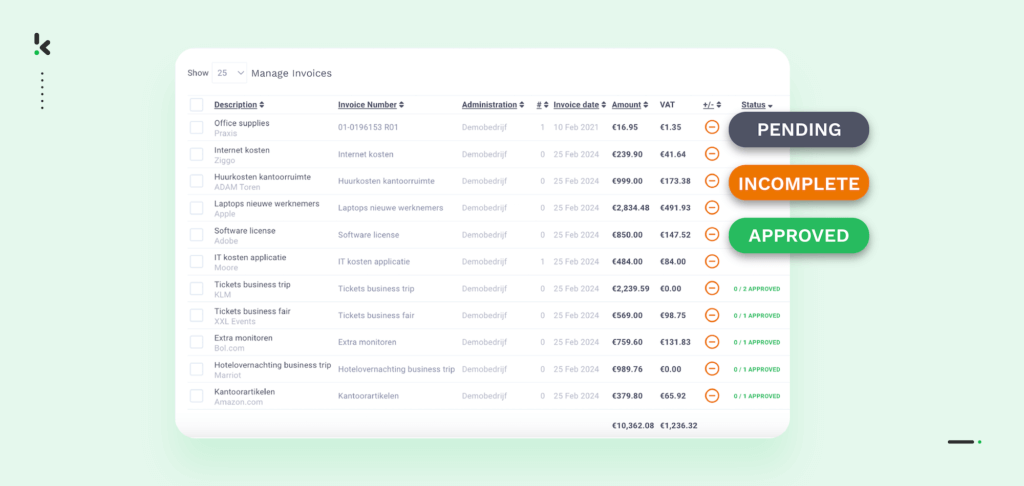
Additionally, Klippa SpendControl offers the following features to AP management:
- Precise document digitization with OCR to automate your data entry
- Accessible mobile and web platforms ensuring constant data availability
- Tailored approval management incorporating advanced business rules and workflows
- Integrated fraud detection leveraging machine learning for document fraud and duplicate detection
- Currency conversion feature to support multiple currencies
- Seamless integration with Google Maps ensures automated mileage tracking
- Smooth incorporation with accounting and ERP software systems
Ready to transform your invoice approval processes? Then schedule a free demo to see our solution in action, or contact our SpendControl experts for more information.
Warning: include(): open_basedir restriction in effect. File(../book_magiks/wp-content/themes/cachild/inc/main-footer.php) is not within the allowed path(s): (C:/Inetpub/vhosts/bookmagiks.com\;C:\Windows\Temp\) in C:\inetpub\vhosts\bookmagiks.com\httpdocs\wp-content\themes\cachild\page-ar-and-ap-management-services-old.php on line 1996
Warning: include(../book_magiks/wp-content/themes/cachild/inc/main-footer.php): Failed to open stream: Operation not permitted in C:\inetpub\vhosts\bookmagiks.com\httpdocs\wp-content\themes\cachild\page-ar-and-ap-management-services-old.php on line 1996
Warning: include(): Failed opening '../book_magiks/wp-content/themes/cachild/inc/main-footer.php' for inclusion (include_path='.;.\includes;.\pear') in C:\inetpub\vhosts\bookmagiks.com\httpdocs\wp-content\themes\cachild\page-ar-and-ap-management-services-old.php on line 1996